
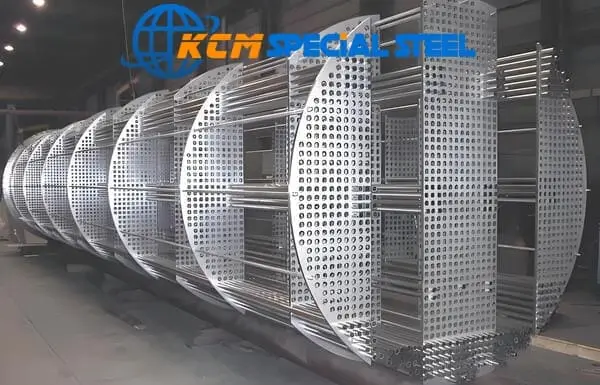
Introduction- Stainless Steel Tube in Condenser
The application of stainless steel materials in condenser tubing dates back to the 1960s. Since then, this technology has matured significantly across the globe. Currently, more than 60% of condensers in the United States use stainless steel tubes.
The total installed length of stainless steel tubes has reached approximately 243.84 million meters. Remarkably, over 96% of these tubes are still in active service today. This impressive track record speaks volumes about the material’s reliability.
In Europe, companies in Germany, France, and other nations began adopting stainless steel tubes for condensers around the 1970s. The technology has since become a well-established industry standard for power plant condenser design.
This article provides a comprehensive feasibility analysis of stainless steel tube application in condensers. It covers technical performance, economic factors, material specifications, and practical recommendations based on international standards and engineering literature.
Historical Background and Global Adoption
The journey of stainless steel tubes in condensers began over six decades ago. Early adoption was driven by the need for better corrosion resistance and longer service life.
| Region | Start Period | Current Adoption Rate |
|---|---|---|
| United States | 1960s | >60% |
| Germany | ~1970s | Widely used |
| France | ~1970s | Widely used |
| Europe (other) | 1970s–1980s | Growing |
The United States leads global adoption. With over 243 million meters installed and a 96% survival rate, stainless steel tubes have proven their worth in the harshest operating environments.
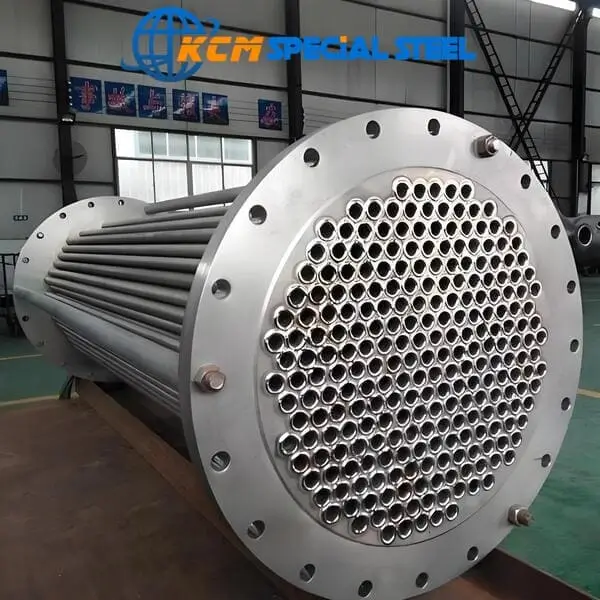
Advantages of Stainless Steel Tube Condensers Over Copper Tube Condensers
Stainless steel tube condensers offer numerous advantages compared to traditional copper tube condensers. These benefits span corrosion resistance, mechanical strength, thermal performance, and lifecycle economics.
1. Excellent Erosion Resistance
Stainless steel tubes exhibit superior resistance to high-velocity water droplet impact from steam. This was recognized as early as the mid-1950s, when the U.S. began placing stainless steel tubes around the periphery of tube bundles.
2. Superior Ammonia Corrosion Resistance
Ammonia-containing media can cause stress corrosion cracking in copper tubes. This phenomenon, known as ammonia corrosion, also leads to condensate corrosion. Stainless steel tubes eliminate the need for additional anti-corrosion measures entirely.
3. Outstanding Water-Side Impact and Sulfide Corrosion Resistance
Stainless steel tubes perform exceptionally well against water-side impact corrosion and sulfide attack. Consequently, ferrous sulfate protection at tube ends is no longer required.
4. Enables Copper-Free Water Systems
With stainless steel tubes, power units can adopt copper-free water systems. The pH value can be raised, which significantly reduces the overall corrosion rate throughout the system.
5. Leak-Free Operation and Extended Service Life
Stainless steel tube condensers can achieve the same leak-free performance as titanium tube condensers. They eliminate the need for frequent tube replacement and maintenance. Their service life is 3–4 times that of copper tubes, reaching 30–40 years — matching the host unit’s lifespan.
| Parameter | Copper Tube | Stainless Steel Tube |
|---|---|---|
| Service Life | 10–15 years | 30–40 years |
| Leak Rate | Moderate | Near zero |
| Maintenance | Frequent | Minimal |
| Life Multiplier | 1× | 3–4× |
6. Higher Cooling Water Velocity and Cleanliness Factor
Cooling water velocity in stainless steel tube condensers can be increased to 2.3 m/s, with a maximum of 3.5 m/s. This improves the overall heat transfer coefficient and helps remove impurities from inside the tubes. The smooth, lustrous surface of stainless steel resists fouling, achieving a cleanliness factor of up to 0.9.
7. Tolerance for High Dissolved Solids
Stainless steel tube condensers can handle cooling water with dissolved solids up to ≤2000 mg/L, making them suitable for a wider range of water quality conditions.
8. Superior Mechanical Properties and Weight Savings
Due to higher strength and elastic modulus compared to copper, stainless steel tubes offer better seismic resistance. The spacing between baffles can be larger for the same tube diameter. Seamless thin-wall welded tubes can also be used.
Although stainless steel tubes cost more per kilogram than copper tubes, the total weight for the same heat transfer area is approximately half that of copper. Therefore, the total material cost for both types is nearly equivalent.
| Property | Copper Tube | Stainless Steel Tube |
|---|---|---|
| Density | 8.9 g/cm³ | 7.9 g/cm³ |
| Elastic Modulus | 110 GPa | 193 GPa |
| Tensile Strength | 220 MPa | 515 MPa |
| Weight (same area) | 100% | ~50% |
| Total Material Cost | Base | ~Equal |
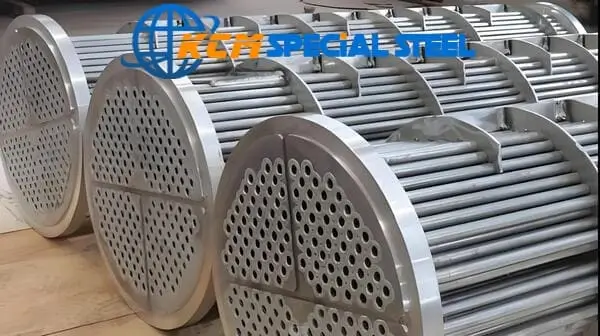
Limitations and Considerations-Stainless Steel Tubing in Condensers
Despite their many advantages, stainless steel tube condensers are not without limitations. Engineers must carefully evaluate the following factors before implementation.
1. Chloride Sensitivity
Stainless steel is sensitive to chloride ions. Therefore, chloride content in cooling water must be strictly controlled. Specific limits depend on the grade of stainless steel selected.
2. Galvanic Corrosion with Copper Tube Sheets
When stainless steel tubes are paired with copper tube sheets, galvanic corrosion and zinc corrosion can occur. Cathodic protection must be implemented to prevent this issue.
3. Pitting Corrosion During Extended Shutdowns
During prolonged shutdowns, calcium deposits can form. Stainless steel grades TP304 and TP316 are susceptible to pitting corrosion under these conditions. Before long-term shutdown, the water chamber and tubes should be flushed with clean water. The chamber covers should be opened and air-dried for two days to prevent FeCl concentration from becoming too high after water evaporation.
4. Corrugated Tube Option
Some domestic and international power equipment manufacturers recommend stainless steel corrugated tubes as an alternative to copper tubes. Heat transfer performance can increase by 25%–30%. However, the pressure drop is higher than that of smooth tubes, and there is no proven track record in large domestic condensers yet.
Common Specifications for Stainless Steel Tubes in Condensers
The following table summarizes the most commonly used specifications for stainless steel condenser tubes based on international standards (HEI, ASTM, EN).
| Specification | Detail |
|---|---|
| Common Grades | TP304, TP304L, TP316, TP316L, TP321, TP347 |
| Outer Diameter | 19 mm (3/4″), 25 mm (1″), 28 mm (1-1/8″) |
| Wall Thickness | 0.4 mm – 0.8 mm (thin-wall welded) |
| Length | 6000 mm – 12000 mm (custom) |
| Standard | ASTM A249, ASTM A269, EN 10216-5 |
| Surface Finish | Bright annealed, smooth (Ra ≤ 0.8 μm) |
| Type | Seamless or welded (welded preferred for cost) |
| Cleanliness Factor | Up to 0.90 |
| Max Cooling Water Velocity | 2.3 m/s (normal), 3.5 m/s (max) |
| Max Dissolved Solids | ≤2000 mg/L |
| Max Chloride (TP304) | ≤300 mg/L |
| Max Chloride (TP316L) | ≤1000 mg/L |
Feasibility Analysis: Technical Perspective
1. Heat Transfer Performance
When replacing admiralty brass tubes with stainless steel tubes in a generator condenser, the heat transfer conditions on both sides of the tube remain unchanged. The heat transfer coefficients on both sides are identical.
Only the tube wall thermal resistance changes due to material and wall thickness differences. However, the wall thickness effect accounts for only about 2% of the total thermal resistance.
The material effect is more significant. According to HEI standards, the material heat transfer coefficient for admiralty brass (φ25×1) is 1.01, while for stainless steel (φ25×0.6) it is 0.89. This means stainless steel has approximately 11% lower material heat transfer coefficient than copper under the same specifications.
| Tube Material | Size | Wall Thermal Coeff. | Reduction vs. Brass |
|---|---|---|---|
| Admiralty Brass | φ25×1 | 1.01 | Baseline |
| Stainless Steel | φ25×0.6 | 0.89 | ~11% lower |
However, the overall heat transfer coefficient has a square-root relationship with velocity. When the cooling water velocity increases from 2 m/s (copper) to 2.3 m/s (stainless steel), the overall heat transfer coefficient improves by approximately 7%.
Furthermore, the smooth surface of stainless steel achieves a cleanliness factor of 0.9. Combining these factors, the overall heat transfer coefficients of both tube types become nearly equivalent.
Moreover, after a period of operation, stainless steel tubes often outperform copper tubes. Fouled and scaled copper tubes can reduce the heat transfer coefficient by up to 50% due to insulation effects from corrosion products and scale.
2. Tube Bundle Vibration
Stainless steel has higher strength and elastic modulus than copper. Originally, tube bundle seismic calculations were based on avoiding resonance at the turbine speed of 3000 RPM, which resulted in large baffle spacing.
Currently, vibration calculations follow the HEI standard empirical formula for preventing steam-flow-induced vibration. This formula is based on the condition where turbine exhaust reaches sonic velocity. The calculated maximum span is approximately 900 mm.
Therefore, whether additional intermediate baffles are needed depends on the original condenser baffle spacing.
| Vibration Criterion | Copper Tube (Old Method) | Stainless Steel (HEI Method) |
|---|---|---|
| Basis | Natural frequency vs. 3000 RPM | Steam-flow-induced vibration (sonic) |
| Max Span | Variable (often larger) | ~900 mm |
| Baffle Spacing | Often large | May need intermediate baffles |
3. Enhanced Corrosion Resistance
Stainless steel offers far superior erosion and corrosion resistance compared to copper. However, austenitic stainless steel is vulnerable to chloride ion attack. The appropriate grade should be selected based on chloride content in the cooling water.
| Chloride Level | Recommended Grade |
|---|---|
| Low (<300 mg/L) | TP304, TP304L |
| Moderate (300–1000 mg/L) | TP316L |
| High (>1000 mg/L) | TP321, duplex 2205, etc. |
4. Tube-to-Tubesheet Joint
If a stainless steel clad tubesheet is used, tubes can be joined by rolling and seal welding. This ensures a leak-free condenser with a service life of 30–40 years.
For tube-only replacement, rolling is used. To ensure leak-tightness, sealant or tubesheet grooving can also be applied.
5. Manufacturing Process
Modern stainless steel tubes for condensers are produced as welded (seam) tubes using automated production lines. The process includes: strip forming → rolling → welding → heat treatment → straightening → cutting → pressure testing → NDT → stress relief → packaging.
This automated process ensures quality comparable to seamless tubes, with more uniform wall thickness, better expansion quality, and lower cost.
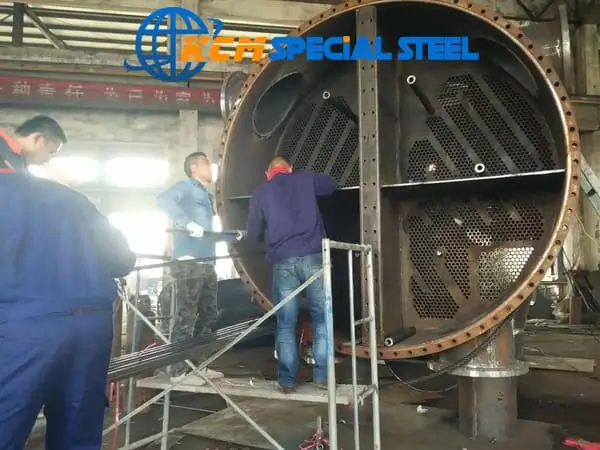
Stainless Steel Tube in Condensers Feasibility Analysis: Economic Perspective
1. Material Cost is Comparable
Contrary to common belief, stainless steel tubes are not significantly more expensive than copper tubes. Welded stainless steel tubes are cheaper than seamless ones. Due to higher strength, thin-wall tubes can be used, reducing weight by approximately 50% for the same heat transfer area.
| Cost Factor | Copper Tube | Stainless Steel Tube |
|---|---|---|
| Unit Price (per kg) | Lower | Higher |
| Wall Thickness | Thicker | Thinner |
| Weight (same area) | 100% | ~50% |
| Total Material Cost | Base | ~Equal |
| Tube Type | Seamless | Welded (cheaper) |
2. Installation Cost
When rolling and seal welding are used for the tube-to-tubesheet joint, an additional welding step is required. This slightly increases installation costs.
3. Operational Savings
Leak-free operation maintains shell-side vacuum and keeps condensate clean. This reduces maintenance work and avoids costly shutdowns caused by condenser leaks.
4. Extended Service Life
With a service life 3–4 times longer than copper tubes, the lifecycle cost of stainless steel tube condensers is significantly lower over a 30–40 year period.
| Economic Factor | Copper Tube | Stainless Steel Tube |
|---|---|---|
| Initial Cost | Lower | Slightly higher |
| Maintenance Cost | High | Low |
| Replacement Frequency | Every 10–15 years | Once in 30–40 years |
| Lifecycle Cost (30 yr) | High | Lower |
| Leak-Related Losses | Frequent | Rare |
Recommendations
Based on the comprehensive technical and economic analysis above, the following recommendations are made:
For existing units with condenser tube leakage or severe copper tube degradation, stainless steel tube replacement is strongly recommended. This is especially true for units approaching mid-life where a major condenser overhaul is planned.
For new units in regions with moderate chloride levels (≤300 mg/L), TP304L welded thin-wall tubes are the most cost-effective choice. For higher chloride environments, TP316L should be specified.
Cathodic protection must be implemented when stainless steel tubes are used with copper or carbon steel tubesheets.
Corrugated stainless steel tubes may be considered for future projects, but more operational data from large-scale domestic installations is needed before widespread adoption.
Conclusion
Stainless steel tube condensers have been proven worldwide for over 60 years. With more than 96% of installed tubes still in service in the United States alone, the technology is mature and reliable.
The technical advantages — including superior erosion resistance, ammonia corrosion immunity, higher allowable water velocity, better cleanliness factor, and 3–4 times longer service life — far outweigh the limitations.
Economically, the total material cost is nearly equivalent to copper tubes, while lifecycle costs are significantly lower. The ability to operate leak-free for 30–40 years makes stainless steel tubes the optimal choice for condenser retrofits and new installations.
For power plants facing copper tube leakage or planning major overhauls, stainless steel tube condensers represent the most feasible and cost-effective solution available today.