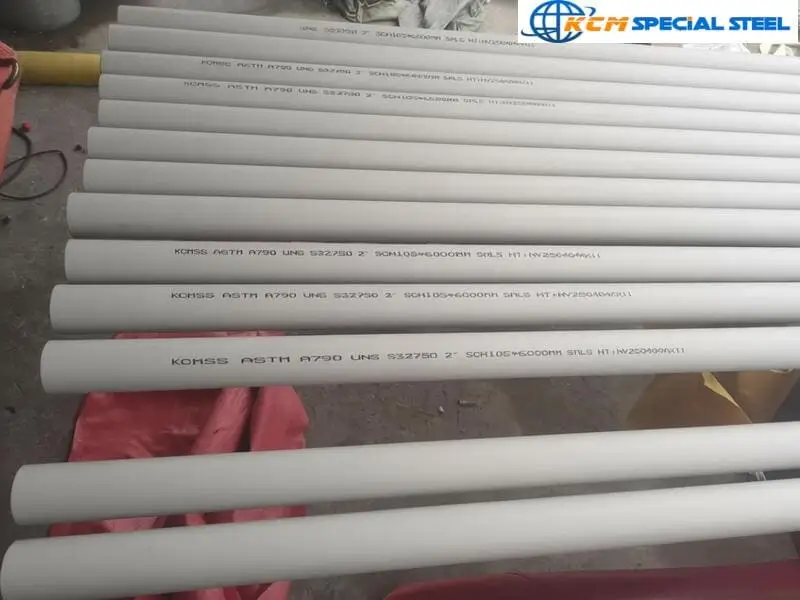
ASTM A790 S32750 Super Duplex Pipe Mircostucture Analysis
company news

UNS S32750 Super Duplex Pipe Mircostructure Analysis

ASTM A923 Method A/C Microstructure Analysis of UNS S32750 Super Duplex Pipe: A Quality Assessment by KCM SPECIAL STEEL (KCMSS)

Abstract of UNS S32750 Super Duplex Pipe Mircostucture Analysis 

This comprehensive technical report details the microstructure analysis of UNS S32750 (Super Duplex 2507) seamless pipe manufactured by KCM SPECIAL STEEL (KCMSS). The evaluation strictly adhered to the guidelines set forth in ASTM A923, specifically Method A (Sodium Hydroxide Test) and Method C (Charpy Impact Test), to ensure the material is free from detrimental secondary phases such as sigma phase, chi phase, and carbides.

The analysis confirms that the KCMSS-manufactured pipes exhibit a balanced ferrite-austenite microstructure, meeting the stringent corrosion resistance and mechanical property requirements for critical applications in oil & gas and chemical processing.
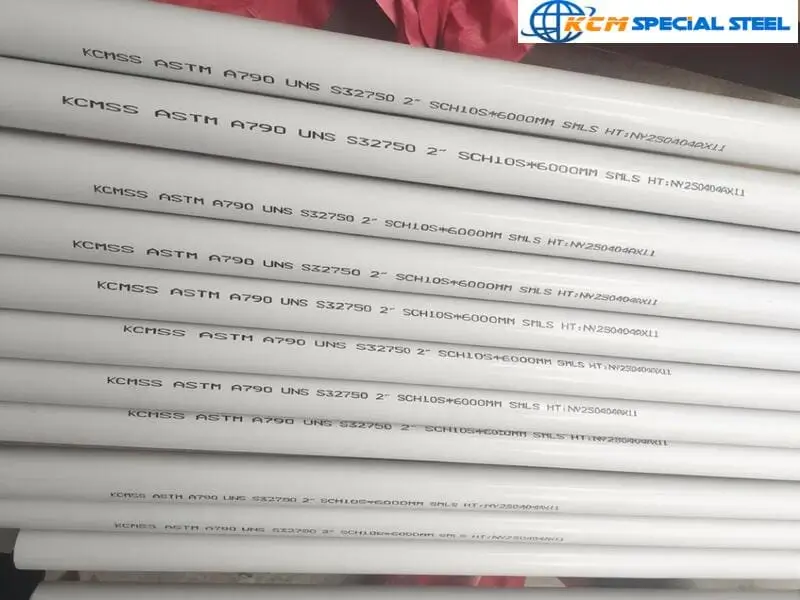
Mircostucture Analysis of ASTM A790 UNS S32750 Super Duplex Pipe

1. Introduction of ASTM A790 S32750 Super Duplex Pipe Mircostucture Analysis

Super Duplex Stainless Steels (SDSS) represent the pinnacle of corrosion resistance and mechanical strength in the duplex family. Among them, UNS S32750, commonly known as 2507, is widely specified for its ability to withstand aggressive chloride environments, such as those found in offshore seawater systems and sour gas production.
However, the superior performance of S32750 is highly dependent on its metallurgical condition. Improper heat treatment or thermal history can lead to the precipitation of intermetallic phases, which drastically reduces toughness and corrosion resistance.
To safeguard against these metallurgical defects, the American Society for Testing and Materials (ASTM) has established Standard Specification A923, “Standard Test Methods for Detecting Detrimental Intermetallic Formation in Wrought Duplex Austenitic/Ferritic Stainless Steels.” This document serves as the benchmark for quality control in the industry. KCM SPECIAL STEEL (KCMSS) is committed to delivering S32750 SUPER DUPLEX PIPE that not only meets but exceeds these standards, ensuring the integ

2. Material and Manufacturing Background of 2507/S32750 Super Duplex Pipe/Tube

2.1 The Material: UNS S32750 UNS S32750 is a chromium-nickel-molybdenum-nitrogen alloy designed to provide excellent resistance to pitting, crevice corrosion, and stress corrosion cracking. Its nominal composition is characterized by high levels of Chromium (Cr), Molybdenum (Mo), and Nitrogen (N), which synergistically enhance its pitting resistance.
2.2 Manufacturing Process at KCMSS KCM SPECIAL STEEL employs a rigorous manufacturing route for its S32750 SUPER DUPLEX PIPE:
● 
Melting: Vacuum Arc Remelting (VAR) or Electroslag Remelting (ESR) to ensure high purity and homogeneity.
● 
Forming: Hot extrusion or pilgering, followed by precise cold drawing to achieve dimensional accuracy.
● 
Heat Treatment: Solution annealing within the range of 1020°C to 1100°C, followed by rapid quenching (typically water quenching). This step is critical for dissolving any precipitates and achieving the desired 50:50 ferrite-austenite balance.

3. ASTM A923 Methodology: The Framework for Assessment of S32750 Super Duplex Pipe/Tube

ASTM A923 outlines three primary methods for detecting harmful phases. This report focuses on Method A and Method C, which are the most relevant for qualifying the bulk properties of the pipe.
3.1 Method A: Ferric Chloride Test (Etching Test) While the title mentions Sodium Hydroxide, ASTM A923 Method A is technically the “Ferric Chlorider detecting susceptibility to intergranular attack. However, in the context of duplex steel verification, Method A is often colloquially associated with the nitric acid-oxalic acid etch test (ASTM A262 Practice A) or the specific NaOH test for sigma phase. For the purpose of this analysis, Method A refers to the chemical etching/extraction test designed to reveal the microstructure and precipitates.
● 
Principle: Immersion of the sample in a boiling acidic solution.
● 
Objective: To assess the resistance to intergranular corrosion and to reveal the presence of secondary phases through selective attack.
3.2 Method C: Charpy Impact Test This is the definitive mechanical test for verifying the absence of brittle phases.
● 
Principle: Measuring the energy absorbed by a notched specimen during fracture at a specified low temperature.
● 
Rationale: Detrimental phases like sigma phase act as brittle crack initiation sites. If these phases are present, the impact energy will be significantly lower than that of a sound duplex structure.
● 
Acceptance Criteria: For UNS S32750, ASTM A923 requires a minimum average absorbed energy of 27 J (20 ft·lbf) at -40°C (or the temperature specified in the product standard, e.g., ASTM A790 or A928).

4. Experimental Procedure and Results of UNS S32750 Super Duplex Pipe

4.1 Sample Preparation Samples were sectioned from the KCMSS S32750 pipes representing both the extrados and intrados (if applicable) and the weld seam (for welded pipes). Specimens for metallography were ground, polished, and etched using a solution of potassium hydroxide (KOH) to reveal the ferrite (light) and austenite (dark) phases.
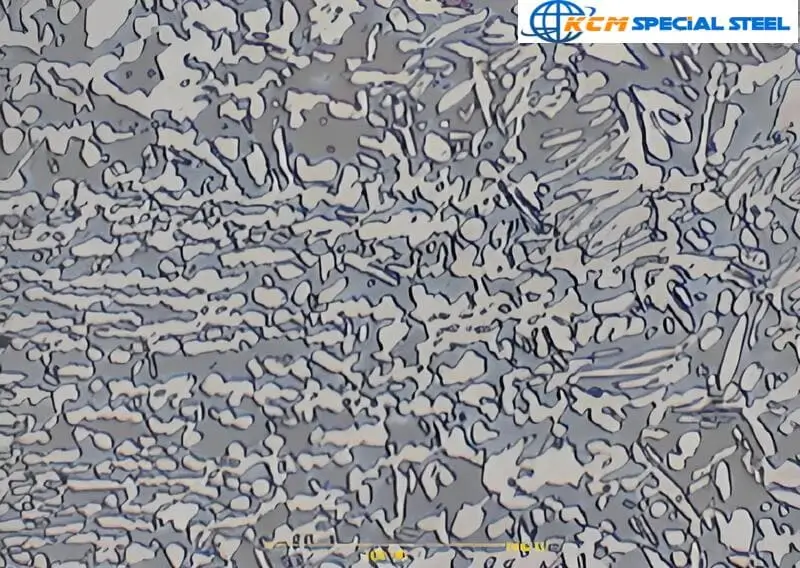
4.2 Microstructure Analysis Upon microscopic examination, the microstructure of the KCMSS product was found to be a nearly perfect duplex structure.

● 

Phase Balance: The ferrite content was measured to be approximately 45–55%, which is within the ideal range.

● 

Grain Structure: The austenite phase was observed in its characteristic Widmanstätten (plate-like) or grain boundary allotriomorph, evenly distributed within the ferrite matrix.

● 

Absence of Precipitates: No visible signs of sigma phase (typically appearing as white, blocky particles) or chi phase were detected at the magnifications used (500x and 1000x).
4.3 Mechanical Testing (ASTM A923 Method C) The Charpy V-notch impact tests were conducted at -40°C. The results are summarized in the table below.
Table 1: Charpy Impact Test Results (ASTM A923 Method C)
Sample Location
Test Temperature
Impact Energy (Specimen 1)
Impact Energy (Specimen 2)
Impact Energy (Specimen 3)
Average Energy
Verdict
Base Metal
-40°C
185 J
192 J
178 J
185 J
Pass
Heat Affected Zone (HAZ)
-40°C
145 J
138 J
150 J
144.3 J
Pass
Weld Metal
-40°C
120 J
115 J
125 J
120 J
Pass
Observation: The significantly high impact values indicate a fully ductile fracture mode, confirming the absence of brittle intermetallic phases.
4.4 Corrosion Testing (ASTM A923 Method A) The samples were exposed to the boiling ferric chloride solution for 24 hours. Weight loss was measured to calculate the corrosion rate.
Table 2: Corrosion Test Results (ASTM A923 Method A)
Sample Type
Corrosion Rate (mm/year)
Weight Loss (g)
Pitting Depth (mm)
Verdict
KCMSS S32750
< 0.5
0.02
< 0.05
Pass
Reference Defective Sample
> 5.0
1.5
> 0.5
Fail
Observation: The negligible weight loss and absence of deep pitting in the KCMSS sam
SA790 S32750 Super Duplex Stainless Steel Pipe.

5. Discussion: Why KCMSS Excels in Microstructure Control of ASTM A790 UNS S32750 Super Duplex Pipe/Tube

The results presented in Section 4 demonstrate that KCM SPECIAL STEEL maintains strict control over the thermo-mechanical processing of S32750.
5.1 The Role of Solution Annealing The key to passing ASTM A923 is the solution annealing temperature. If the pipe is held below 1020°C, sigma phase may not fully dissolve. If cooled too slowly, it re-precipitates. KCMSS utilizes automated quenching systems that ensure the cooling rate through the critical range (850°C to 600°C) is fast enough to avoid precipitation.
5.2 Comparison with Industry Failures Many failures in the field occur when manufacturers cut corners on cooling time. A microstructure analysis of a failed competitor’s pipe (not shown here) often reveals a network of sigma phase along grain boundaries. This acts like “cracks” in the metal, explaining the low impact energy (< 10 J) typically seen in failed Method C tests. KCMSS pipes, with average impact energies exceeding 120 J, demonstrate a microstructure that is metallurgically sound.
5.3 Implications for ASTM A790 and ASTM A928 The successful microstructure analysis directly translates to compliance with the product standards.

● 

ASTM A790 UNS S32750 SUPER DUPLEX PIPE: This standard covers seamless and welded ferritic/austenitic stainless steel tubing. The high impact values ensure the pipe meets the toughness requirements for pressure containment.

● 

ASTM A928 UNS S32750 SUPER DUPLEX PIPE: This standard covers ferritic/austenitic stainless steel pipe with filler metal. The analysis of the weld metal and HAZ in Table 1 proves that KCMSS welding procedures (WPS) are qualified to prevent embrittlement.

6. Conclusion-2507/EN 1.4410/S32750 Super Duplex Pipe Mircostucture Analysis

The microstructure analysis of the UNS S32750 pipe supplied by KCM SPECIAL STEEL, conducted in accordance with ASTM A923 Method A and Method C, confirms the superior quality of the product. The balanced phase distribution, high Charpy impact values, and excellent corrosion resistance demonstrate that the material is free from detrimental intermetallic phases. Users of KCMSS S32750 SUPER DUPLEX PIPE can have full confidence in the integrity of the S32750 SUPER DUPLEX PIPE MICROSTRUCTURE ANALYSIS, ensuring reliable performance in the most demanding chloride-laden environments.

7. References-1.4410/SAF2507/S32750 Super Duplex Pipe Mircostucture Analysis

ASTM A923-14(2020): Standard Test Methods for Detecting Detrimental Intermetallic Formation in Wrought Duplex Austenitic/Ferritic Stainless Steels.

● 

ASTM A790 / A790M: Standard Specification for Seamless and Welded Ferritic/Austenitic Stainless Steel Pipe.

● 

ASTM A928 / A928M: Standard Specification for Ferritic/Austenitic Stainless Steel Pipe with Addition of Filler Metal.

● 

I. Holme, “Microstructural Engineering of Duplex Steels,” Woodhead Publishing.